Hey there, budding engineers! Ever felt like your photonics homework is a mountain you just can’t climb? You’re not alone. Photonics is a fascinating but complex field, and mastering its concepts is crucial for anyone looking to make waves in modern technology. In this article, we’ll break down photonics, explore common challenges, and give you the tools you need to conquer your homework with confidence. Plus, we’ll introduce you to Virtual Help, a fantastic resource for all your assignment needs. Ready? Let’s dive in!
What is Photonics?
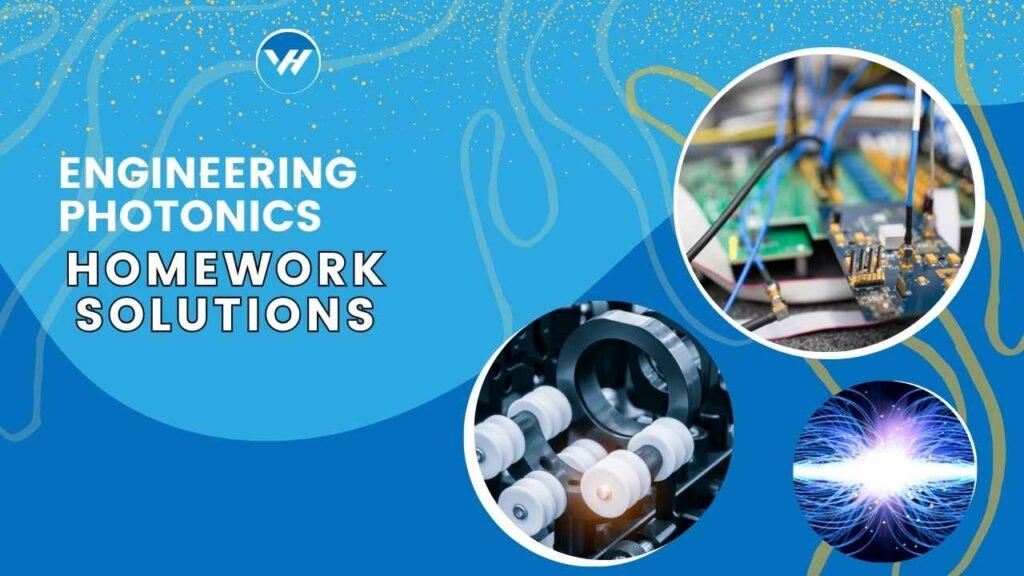
Photonics is all about the science of light. It involves the generation, emission, transmission, modulation, signal processing, switching, amplification, and detection of light. This field isn’t just limited to visible light; it covers infrared, ultraviolet, and other forms of electromagnetic radiation as well. From the screens of our smartphones to the fibers that deliver high-speed internet, photonics is everywhere.
Why Study Photonics?
So, why should you care about photonics? Well, for starters, it’s at the heart of countless modern technologies. Think about lasers used in medical procedures, the fiber optics that form the backbone of our internet, or even the solar cells that harness sunlight to power our homes. Photonics is a gateway to exciting career opportunities in fields like telecommunications, healthcare, environmental monitoring, and beyond.
Common Challenges in Photonics Homework
Let’s be real—photonics can be tough. The theories and principles are intricate, the mathematical computations can be mind-bending, and lab work often requires meticulous attention to detail. Many students struggle with visualizing abstract concepts and applying them in practical scenarios. But don’t worry, we’re here to help you navigate these challenges.
Effective Strategies for Tackling Photonics Homework
Facing a tough photonics assignment? Here are some strategies to make it more manageable:
- Break Down Complex Problems: Take a deep breath and tackle each part of the problem step by step. Breaking it down can make it less overwhelming.
- Utilize Visual Aids and Simulations: Diagrams, charts, and simulations can be incredibly helpful for understanding how light behaves in different scenarios.
- Group Study and Discussions: Sometimes, two (or more) heads are better than one. Discussing problems with classmates can provide new insights and make learning more interactive.
Resources for Photonics Students
Having the right resources at your fingertips can make a world of difference. Here are some you might find useful:
- Textbooks and Reference Materials: Look for well-reviewed books that cover both theoretical and practical aspects of photonics.
- Online Courses and Tutorials: Websites like Coursera, edX, and Khan Academy offer courses that can supplement your learning.
- Academic Journals and Papers: Stay updated with the latest research by reading journals like the IEEE Photonics Journal or Optics Express.
How Virtual Help Can Assist with Photonics Homework
Struggling with a tricky concept or need help with an assignment? Virtual Help is here for you. This platform connects you with tutors and provides comprehensive assignment assistance through its iOS and Android app. With features like 24/7 availability, expert tutors, and personalized help, Virtual Help is your go-to for photonics homework solutions.
Detailed Breakdown of Photonics Topics
Let’s delve deeper into some key photonics topics:
Light Propagation
Understanding how light travels is fundamental to photonics.
- Fundamentals of Light Waves: Light behaves both as a wave and a particle. Grasping this duality is essential.
- Reflection, Refraction, and Diffraction: These phenomena explain how light interacts with different surfaces and mediums.
Optical Fibers
Optical fibers are the backbone of modern communication systems.
- Structure and Function: Learn how optical fibers are designed to transmit light over long distances with minimal loss.
- Applications in Communication: From internet cables to medical imaging, optical fibers have a wide range of uses.
Lasers and Their Applications
Lasers are a cornerstone of photonics.
- Types of Lasers: Understand the differences between gas, solid-state, and semiconductor lasers.
- Uses in Medicine, Industry, and Research: Lasers have applications in everything from surgery to manufacturing and scientific research.
Photonics in Telecommunications
Photonics plays a crucial role in data transmission.
- Role of Photonics in Data Transmission: Discover how photonics enables high-speed, high-capacity communication networks.
- Recent Advancements: Stay updated with the latest technologies and innovations in photonics-based telecommunications.
Hands-On Photonics Projects for Students
Get your hands dirty with some practical projects.
- DIY Projects and Experiments: Simple experiments, like building a basic laser communicator, can enhance your understanding.
- Importance of Practical Experience: Hands-on projects bridge the gap between theory and practice.
Tips for Excelling in Photonics Courses
Want to ace your photonics course? Here are some tips:
- Time Management and Planning: Allocate specific times for studying and stick to your schedule.
- Active Participation in Class: Engage with the material by asking questions and participating in discussions.
- Seeking Help from Professors and Peers: Don’t hesitate to reach out for help when you need it.
The Role of Simulation Software in Photonics
Simulation software can be a game-changer for understanding photonics.
- Popular Simulation Tools: Tools like COMSOL Multiphysics and OptiFDTD are widely used.
- How to Use Them Effectively: Learn the basics of these tools and how they can help you visualize and solve complex problems.
- Benefits of Simulations in Understanding Concepts: Simulations can make abstract concepts more tangible.
Preparing for Photonics Exams
When exam time rolls around, preparation is key.
- Study Techniques: Use techniques like spaced repetition and active recall to reinforce your learning.
- Practice Problems: Work through past exam papers and sample problems.
- Review and Revision Strategies: Regularly review your notes and highlight key concepts.
Future Trends in Photonics
Stay ahead of the curve by knowing what’s coming next.
- Emerging Technologies: Keep an eye on innovations like quantum photonics and photonic computing.
- Potential Impact on Various Industries: Consider how these advancements might affect fields like healthcare, communications, and energy.
Conclusion
To wrap things up, mastering photonics requires a solid understanding of its principles, effective study strategies, and access to the right resources. By leveraging tools like Virtual Help and staying curious about emerging trends, you can navigate the challenges of photonics homework and excel in your studies. Keep pushing forward, and remember, the world of photonics is as bright as the light it studies!
FAQs
What is the best way to study photonics?
Break down complex concepts into manageable parts, use visual aids, and practice regularly. Group studies and discussions can also be very helpful.
How can I find a tutor for photonics homework?
Platforms like Virtual Help connect you with expert tutors who can assist you with photonics assignments and concepts.
Are there any good online resources for photonics students?
Yes, websites like Coursera, edX, and academic journals like IEEE Photonics Journal are excellent resources.
What are some common mistakes to avoid in photonics assignments?
Avoid skipping steps in calculations, not double-checking your work, and neglecting the theoretical background of practical problems.
How can Virtual Help improve my understanding of photonics?
Virtual Help offers personalized tutoring, 24/7 assistance, and a wealth of resources to help you tackle photonics assignments and enhance your understanding of the subject.